
Few things are more frustrating than getting into your car, turning the key or pressing the start button, and nothing happens.
Maybe the dashboard lights come on, but the engine does not turn over. Maybe you hear a clicking sound. Maybe the car is completely dead. Or maybe it cranks like normal but refuses to start.
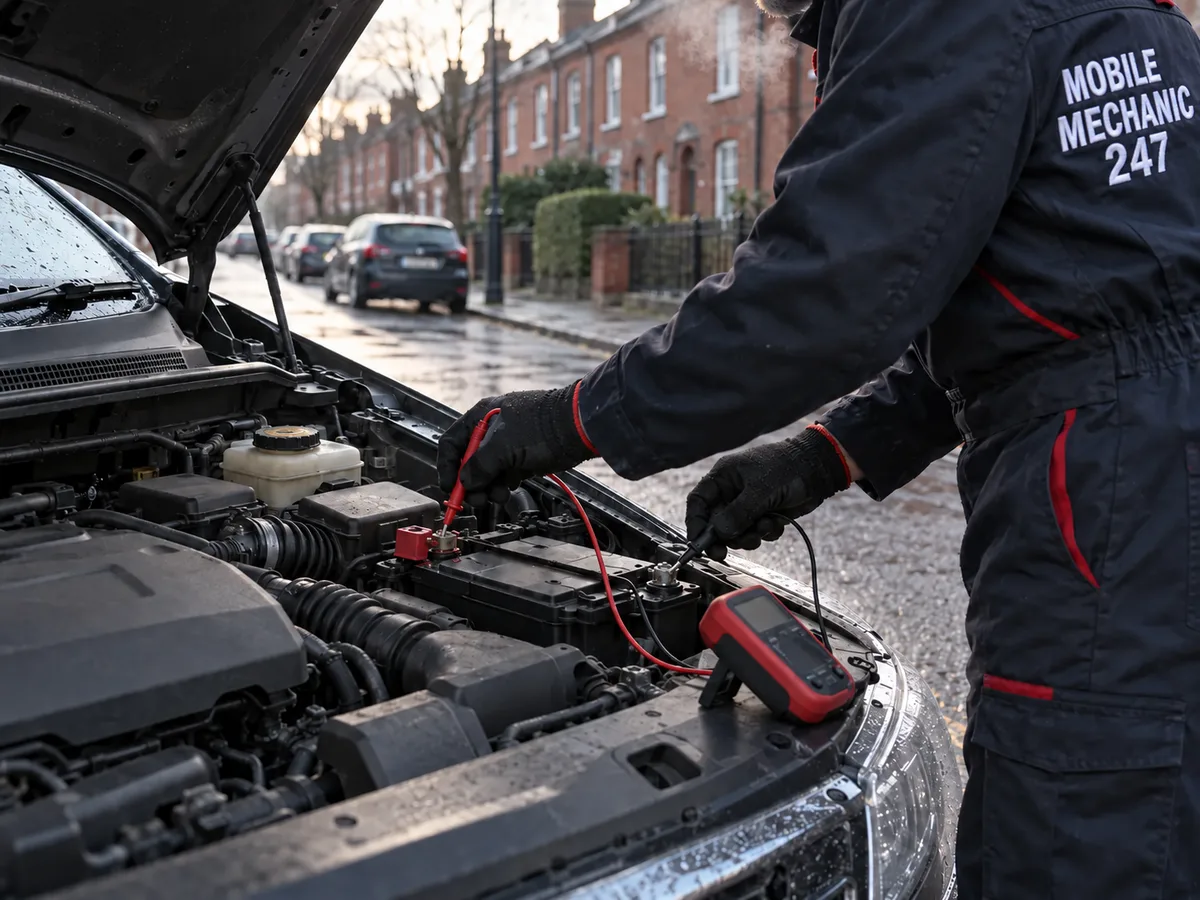
The good news is that a car that won’t start is usually caused by a few common issues. Some are simple, like a flat battery. Others may need a mobile mechanic to diagnose the fault at your home, workplace, or roadside.
In this guide, we’ll look at 10 common reasons your car won’t start, what each one means, and what you should do next.
First: What Happens When You Try to Start the Car?
Before guessing the problem, pay attention to what the car does.
Ask yourself:
- Does the engine crank?
- Do you hear clicking?
- Are the dashboard lights on?
- Are the headlights dim?
- Is there silence when you turn the key?
- Did the car recently show a warning light?
- Did this happen after leaving the car parked for days?
- Did it happen after refuelling?
These clues can help narrow down the problem. For example, rapid clicking is often linked to a battery or electrical issue, while a single click may point towards the starter motor. The AA notes that starting symptoms can often give clues about whether the issue is battery-related, alternator-related, or connected to the starter system.
10 Common Reasons Your Car Won’t Start
1. Flat or Weak Battery
A flat battery is one of the most common reasons a car won’t start.
You may notice:
- Rapid clicking when you turn the key
- Dashboard lights flickering
- Headlights looking dim
- The engine turning slowly
- No response at all when trying to start
Car batteries can go flat for many reasons, including short journeys, leaving lights on, cold weather, an old battery, corrosion, or a fault in the charging system. AA Ireland lists flat batteries as a top cause of breakdowns and notes that short journeys, unused cars, charging faults, corrosion, and temperature changes can all contribute.
What to do next
Try switching off everything electrical, including lights, radio, heater, dashcam, and phone chargers. Then try starting the car again.
If the battery is weak, a jump start may get you moving. But if the battery keeps dying, you may need a battery test or replacement.
Best action: Call a mobile mechanic if the car needs a jump start, battery test, or roadside battery replacement.
2. Loose or Corroded Battery Terminals
Sometimes the battery itself is not the main problem. The connection may be poor.
Battery terminals can become loose, dirty, or corroded over time. When this happens, power may not flow properly from the battery to the car.
You may notice:
- No power when trying to start
- Intermittent starting problems
- Dashboard lights coming and going
- White, green, or blue powder around the battery terminals
What to do next
Do not force or pull at the battery cables if you are not sure what you are doing. A poor connection can sometimes be fixed quickly, but it should be checked properly.
Best action: Ask a mechanic to inspect the terminals, battery condition, and charging system.
3. Faulty Starter Motor
The starter motor is the part that physically turns the engine when you start the car.
If the starter motor fails, the battery may still have power, but the engine will not turn over.
You may notice:
- A single click when trying to start
- Dashboard lights working normally
- Headlights working
- Engine not cranking
- Starting issue becoming worse over time
What to do next
If the starter motor is faulty, a jump start may not fix the problem. The car may need diagnosis and repair.
Best action: Call a mobile mechanic to confirm whether the fault is the starter motor, battery, relay, wiring, or ignition system.
4. Alternator Fault
The alternator charges your battery while the engine is running. If it fails, your car may start once, then die later because the battery is no longer being charged.
You may notice:
- Battery warning light on the dashboard
- Dim headlights
- Electrical problems
- Car starts after a jump but dies again later
- Repeated flat battery issues
AA Ireland notes that persistent battery problems and dim headlights while the engine is idling can point to alternator or generator faults.
What to do next
If your battery keeps going flat, don’t assume the battery is the only issue. The alternator may be failing.
Best action: Get the battery and alternator tested before replacing parts.
5. Fuel Problem
Your car needs the right amount of fuel to start and run. If fuel is not reaching the engine, the car may crank but not start.
Possible fuel-related causes include:
- Empty fuel tank
- Wrong fuel added
- Faulty fuel pump
- Blocked fuel filter
- Fuel system fault
You may notice:
- Engine cranking but not starting
- Car cutting out before refusing to restart
- Fuel gauge very low
- No fuel pump sound when ignition is turned on
- Problem starting after refuelling
What to do next
First, check the fuel level. If you recently added fuel and the car stopped running, do not keep trying to start it, especially if you suspect the wrong fuel was added.
Best action: If you used the wrong fuel, stop immediately and call for fuel assist.
6. Immobiliser or Key Problem
Modern cars use electronic keys and immobiliser systems. If the car does not recognise the key, it may not start.
You may notice:
- Key warning light on the dashboard
- Car unlocks but does not start
- Push-button start does nothing
- Spare key works but main key does not
- “Key not detected” message
This can happen because of a weak key fob battery, damaged key, immobiliser fault, or communication issue between the key and the car.
What to do next
Try using the spare key if you have one. If it works, the issue may be with your main key.
Best action: If the key is lost, damaged, locked inside, or not recognised, call a mobile car locksmith or mechanic.
7. Faulty Ignition Switch
The ignition switch sends power to important systems when you turn the key or press the start button.
If it fails, the car may not start even if the battery is healthy.
You may notice:
- No response when turning the key
- Dashboard lights not behaving normally
- Car starts sometimes but not always
- Key feels loose or difficult to turn
- Electrical accessories work, but engine does not start
What to do next
This is not usually a DIY fix. Ignition faults need proper diagnosis because symptoms can overlap with battery, key, starter, and wiring problems.
Best action: Get the car inspected by a mechanic who can test the ignition and starting circuit.
8. Engine Sensor Fault
Modern cars rely on sensors to start and run properly. If an important sensor fails, the engine may crank but not start.
Common sensor-related issues include:
- Crankshaft position sensor fault
- Camshaft position sensor fault
- Mass airflow sensor fault
- Coolant temperature sensor fault
You may notice:
- Engine cranks but won’t start
- Check engine light
- Car starts when cold but not when hot
- Car cuts out randomly
- Rough running before the issue started
What to do next
A diagnostic scan can usually help identify the fault code. This is where a mobile diagnostics service can save time.
Best action: Book a mobile mechanic diagnostic check.
9. Blown Fuse, Relay, or Wiring Fault
A small electrical fault can stop the car from starting.
This could include:
- Blown starter fuse
- Faulty fuel pump relay
- Damaged wiring
- Bad earth connection
- ECU power issue
You may notice:
- No crank
- No fuel pump sound
- Random electrical faults
- Warning lights
- Car worked fine yesterday, then suddenly stopped
What to do next
Avoid randomly replacing fuses unless you know what caused the problem. A fuse usually blows for a reason.
Best action: Get the electrical system checked properly.
10. Weather-Related Starting Problems
Cold and damp Irish weather can make existing car problems worse.
You may notice:
- Car struggles to start in the morning
- Battery feels weaker in winter
- Engine cranks slowly
- Older diesel car takes longer to start
- Problems after the car has been parked for days
Cold weather can reduce battery performance, while damp conditions can affect older ignition components.
What to do next
If your car struggles to start during cold weather, don’t ignore it. It may be an early warning that the battery, glow plugs, alternator, or ignition system needs attention.
AA Ireland notes that batteries often give early warning signs, such as the car taking longer to start or making clicking noises.
Best action: Get the car checked before it leaves you stranded.
What Should You Do If Your Car Won’t Start?
1. Stay Calm and Check Your Surroundings
If you are parked safely at home, at work, or in a car park, you have more time to check the basics.
If you are on the roadside, safety comes first.
Turn on your hazard lights and make sure you and your passengers are safe. If your vehicle breaks down on a motorway, the RSA advises moving to the hard shoulder if possible, switching on hazard lights, and contacting a recovery operator.
2. Do Not Keep Forcing the Engine
If the car does not start after a few tries, stop.
Repeatedly trying to start the car can:
- Drain the battery further
- Flood the engine in some vehicles
- Damage the starter motor
- Make the problem worse
Try to notice the symptoms instead. Clicking, silence, slow cranking, or cranking without starting all point to different issues.
3. Check the Simple Things
Before calling for help, check:
- Is the car in Park or Neutral?
- Is the clutch fully pressed?
- Is there fuel in the tank?
- Are the headlights bright or dim?
- Is there a warning light on the dashboard?
- Is the key battery working?
- Is the steering lock engaged?
- Did you recently add fuel?
- Did you leave lights or accessories on?
These checks may help you explain the issue clearly when calling a mechanic.
4. Avoid DIY Repairs on Busy Roads
Do not attempt repairs in unsafe locations, especially on motorways or busy roads.
The RSA motorway guidance says not to place a warning triangle on a motorway, and to wear a high-visibility vest where possible.
For non-motorway breakdowns, use caution, stay visible, and only exit the vehicle if it is safe.
5. Call a Mobile Mechanic
If the car is at home, work, a car park, or safely parked at the roadside, a mobile mechanic may be able to help without needing a tow truck.
A mobile mechanic can often assist with:
- Jump starts
- Battery testing
- Battery replacement
- Starter motor diagnosis
- Alternator checks
- Diagnostic scans
- Fuel issues
- Key and lockout issues
- Electrical fault checks
- Roadside repair advice
This can save time because the mechanic comes to the vehicle.
Car Won’t Start at Home vs on the Road
If Your Car Won’t Start at Home
This is usually less stressful. You can safely wait for help and avoid towing the car unnecessarily.
A mobile mechanic can come to your driveway, inspect the car, test the battery, run diagnostics, and advise whether the vehicle can be repaired on-site.
If Your Car Won’t Start at Work
This is common when the battery is weak. The car may have started in the morning but failed later in the day.
A mobile mechanic can come to your workplace and help you get back on the road.
If Your Car Won’t Start on the Roadside
Safety comes first. Move away from traffic where possible, turn on hazard lights, and call for help.
Do not attempt to inspect the engine or battery if the car is in a dangerous location.
When Is It a Battery Problem?
Your car may have a battery problem if:
- You hear rapid clicking
- Dashboard lights are dim
- The engine turns slowly
- The car starts with a jump
- The battery is over 3–5 years old
- The issue is worse in cold weather
- You only drive short distances
A jump start may work, but it does not always solve the root issue. If the battery is old or failing, the car may refuse to start again later.
When Is It Not a Battery Problem?
It may not be the battery if:
- The engine cranks strongly but won’t start
- You smell fuel
- The car starts sometimes but not always
- A warning light appeared before the issue
- The battery is new but keeps going flat
- A jump start does not work
- You hear one single click instead of rapid clicking
In these cases, the issue could be the starter motor, alternator, fuel system, immobiliser, sensor, or wiring.
Should You Call a Mobile Mechanic or Tow Truck?
Call a mobile mechanic if:
- The car is parked safely
- You need a jump start
- You suspect a battery issue
- The car needs diagnostics
- You want to avoid towing if possible
- The issue may be fixable on-site
Call a tow truck or recovery service if:
- The car is in a dangerous location
- The vehicle cannot be repaired roadside
- The car has major mechanical damage
- The engine overheated badly
- There is smoke, fluid leakage, or accident damage
- A mechanic advises the car should not be driven
How to Explain the Problem When Calling for Help
When calling a mobile mechanic, give clear details.
Mention:
- Your exact location
- Car make and model
- Registration if available
- Whether the car is manual or automatic
- What happens when you try to start it
- Any clicking sounds
- Dashboard warning lights
- Whether the headlights work
- Whether the engine cranks
- Any recent repairs
- Whether you recently refuelled
- Whether the car is parked safely
The more detail you give, the easier it is for the mechanic to arrive prepared.
How to Prevent Starting Problems
You cannot prevent every breakdown, but you can reduce the risk.
Keep the Battery Healthy
Drive the car regularly, especially during colder months. Short trips may not give the battery enough time to recharge.
Watch for Slow Starting
If the car takes longer to start, get it checked early. Slow starting is often a warning sign.
Pay Attention to Warning Lights
Do not ignore battery, engine, oil, or temperature warning lights. AA Ireland warns that a battery charge light can point to issues such as loose terminals, alternator failure, or a loose/broken alternator belt.
Service the Car Regularly
Regular servicing can catch worn parts, weak batteries, and electrical issues before they become breakdowns.
Keep Emergency Items in the Car
Useful items include:
- High-visibility vest
- Torch
- Phone charger
- Warning triangle, where safe and legal to use
- Jump leads or battery booster
- Basic first aid kit
- Water
- Warm clothing in winter
Need Help With a Car That Won’t Start in Dublin?
If your car won’t start, MobileMechanic247 can help with fast mobile mechanic call-outs in Dublin.
Whether it’s a flat battery, starter problem, alternator fault, fuel issue, key problem, or unknown fault, we can come to your location and inspect the vehicle.
Call MobileMechanic247 today for mobile mechanic assistance in Dublin.
FAQs
Why won’t my car start but the lights come on?
If the lights come on but the car won’t start, the battery may still be weak. Lights use less power than the starter motor. It could also be the starter motor, ignition switch, relay, or immobiliser.
Why does my car click but not start?
Rapid clicking often points to a weak battery or electrical issue. A single click may suggest a starter motor problem.
Can a mobile mechanic fix a car that won’t start?
Yes, in many cases. A mobile mechanic can test the battery, scan for fault codes, check the starter system, inspect connections, and diagnose common starting problems.
Should I jump start my car?
A jump start may help if the battery is flat. But if the battery is damaged, old, or not charging properly, the issue may return. If you are unsure, call a mechanic.
Why does my car crank but not start?
If the engine cranks but does not start, the issue may be fuel, ignition, sensor, immobiliser, or engine management related.
Can cold weather stop a car from starting?
Yes. Cold weather can reduce battery performance and make existing faults worse, especially if the battery is old or weak.
What should I do if my car won’t start on the motorway?
Move to the hard shoulder if possible, turn on hazard lights, leave the vehicle safely if appropriate, stay away from traffic, and call for recovery or roadside assistance. Do not try to repair the car in a dangerous location.
Is it better to call a mobile mechanic or tow the car?
If the car is parked safely, call a mobile mechanic first. If the issue can be fixed or diagnosed on-site, you may avoid towing. If the vehicle is unsafe or cannot be repaired roadside, recovery may be needed.