
The red battery symbol does not mean your battery is faulty. It means the charging system is not putting enough power back into the battery while the engine runs, and on most cars that points to the alternator, its belt or the wiring between them. The car will keep going on battery power for a while, but not for long, so it needs attention the same day.
What the battery light actually measures
The alternator is a small generator driven by a belt from the engine. While the engine runs, it powers the lights, heater, wipers and electronics, and tops the battery up. The warning light compares the voltage the alternator should produce with what it is actually producing. If the output drops, the light comes on.
It is normal for the light to show for a second when you first turn the ignition on, before the engine starts. It should go off as soon as the engine is running. A light that stays on, or comes on while you are driving, is the problem.
Battery or alternator: the quick way to tell
It is more likely the alternator if:
– The light came on while driving, not just at start-up.
– Headlights dim at idle and brighten when you rev.
– The dashboard flickers, the radio cuts out or the electric windows slow down.
– You hear a whine or grinding from the front of the engine that changes with revs.
– There is a smell of hot rubber, which can mean a slipping belt.
– The car started fine this morning but is now losing electrics one by one.
It is more likely the battery if:
– The car struggles to start but runs perfectly once going, and the light goes out.
– The battery is several years old, or the terminals are white and crusty.
– The car has been sitting unused.
In practice the two overlap. A failing alternator slowly flattens a healthy battery, and a dead battery cell can overload an alternator. That is why a proper test checks both at the same time, with the engine off and running.
The belt problem you need to know about
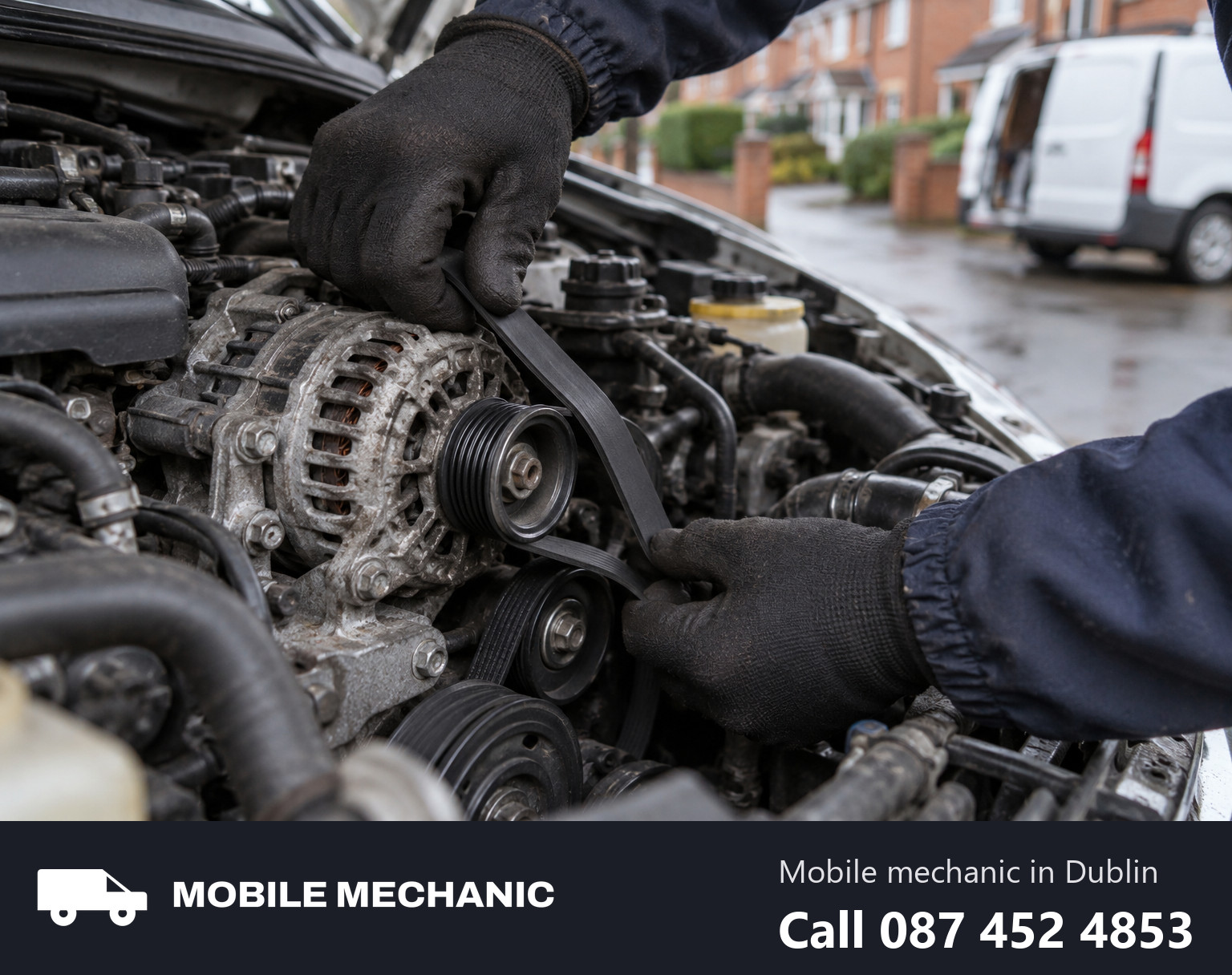
On most cars one belt, often called the auxiliary or serpentine belt, drives the alternator and may also drive the power steering pump, the air conditioning compressor and in some engines the water pump.
If that belt snaps, three things can happen in quick succession: the battery light comes on, the steering goes heavy, and the temperature gauge starts to climb because coolant is no longer being circulated. If you notice the battery light and a sudden change in the steering at the same time, pull over somewhere safe as soon as you can and switch off. Driving on with no water pump can overheat the engine within minutes.
How far can you drive with the battery light on?
There is no safe number to give you. It depends on how much charge the battery has left, how old it is, and how much the car is using. Headlights, heated rear window, wipers and heater fan all take their share. On a wet, dark winter evening in Dublin with everything on, a battery can run down surprisingly fast.
If you must keep going to get somewhere safe:
- Switch off everything you do not need: heated screen, heated seats, air conditioning, radio, phone charging.
- Keep headlights on if it is dark or raining. That is the law and your safety.
- Avoid stop-start traffic where possible. The engine does not need the battery once it is running, but every restart does.
- Do not switch the engine off until you are parked where the car can stay. It may not start again.
Once the battery runs flat, the engine management, fuel pump and ignition lose power and the car stops wherever it is. That is the real risk, not the light itself.
What else can turn the light on
- Loose or corroded battery terminals. Cheap to fix and easy to miss.
- A worn belt tensioner letting the belt slip only when wet or under load, so the light flickers rather than staying on.
- A blown fuse or fusible link in the charging circuit.
- A failed voltage regulator inside the alternator. The alternator spins but cannot control its output.
- On some cars, a software or sensor fault rather than a mechanical one. A diagnostic read of the stored codes shows the difference.
What a proper test looks like
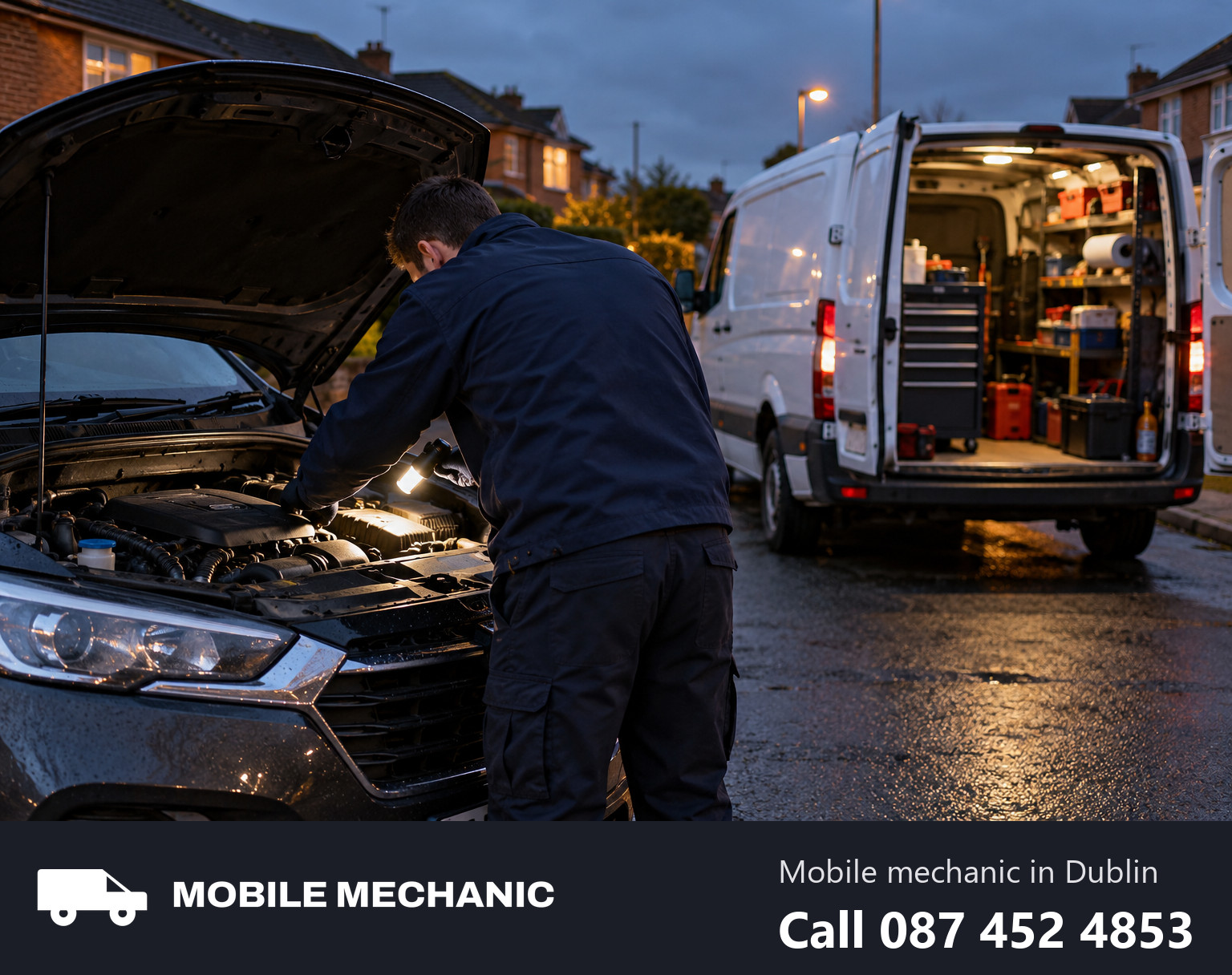
A charging system test takes a few minutes with the right equipment and does not need a garage. We check the resting voltage of the battery, then the voltage with the engine running and with electrical loads switched on, then the condition and tension of the belt and the state of the terminals and earth connections. If the figures are wrong we can say whether it is the battery, the alternator or the wiring. A warning light diagnosis at your door covers all of this, and the price is agreed before we start.
If the car has already stopped and will not restart, our car won’t start diagnosis works through it in the same way.
FAQ
Can I just replace the battery and see?
You can, but if the alternator is the fault you will flatten the new battery too. Test first, replace second.
The light flickers, then goes off. Is that fine?
No. A flickering charge light is usually a belt that slips, a worn tensioner or an alternator on its way out. It will get worse, often on a wet day.
My car is start-stop. Does that change anything?
Start-stop cars have more demanding charging systems and specific battery types. The warning works the same way, but repairs need the right parts and sometimes the battery has to be registered to the car’s electronics.
Is it safe to jump start a car with a bad alternator?
It may start, but it will stop again when the battery drains. A jump start gets it moving; it does not fix the charging fault.
Battery light on in Dublin? Call us
Tell us what the light is doing and whether the steering or the temperature has changed. We come to the car, test the battery and the charging system together and explain what we find before anything is done. Phone Mobile Mechanic 247 on 087 452 4853. More common questions are answered on our FAQ page.